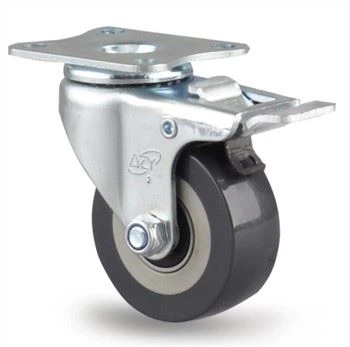
If you’ve ever tried moving a heavy load on a cart or equipment that feels like it’s one caster away from tipping, you know how critical it is to get load capacity right. As a supplier of medium-duty TPR casters, I talk to warehouse managers, equipment designers, and small business owners every week who ask the same question: “What’s the actual static load capacity of these casters, and why does it matter more than just a number on a spec sheet?” Static load capacity is the maximum weight a caster can support when it’s stationary, no movement or shock involved—it’s the baseline that keeps your loads safe, your equipment functional, and your team from dealing with broken parts or damaged goods. When it comes to medium-duty TPR casters, this number isn’t a one-size-fits-all figure; it’s shaped by a handful of factors that I’ve learned to walk through with every customer, because getting it wrong leads to avoidable headaches.
First, let’s define what medium-duty means in the caster world, because that label varies a lot between brands. At our company, medium-duty casters sit between light-duty models for small conveyors or rolling office furniture and heavy-duty units for construction equipment or 1,000+ lb pallets. Light-duty casters like our 63mm Light Duty PU Casters For Conveyors are built for loads up to around 200 lbs each, perfect for small conveyor belts or light storage carts, while heavy-duty can support 1,000 lbs and up. Medium-duty TPR casters, then, are designed for loads that range roughly from 300 lbs to 800 lbs per caster—but that’s a general range, not a hard rule.
TPR, or Thermoplastic Rubber, is the wheel material most of our medium-duty casters use, and it’s a big part of why static load capacity works the way it does. TPR is a flexible, non-marking material that’s gentle on floors, which makes it popular for hospitals, retail spaces, and clean rooms where scuff marks or chemical resistance matter. But its flexibility also means that under a heavy static load, the wheel compresses slightly, distributing weight across the contact area with the floor. That’s a good thing when it’s within the capacity limit, because it prevents pressure points that could break the wheel or damage the floor. Push that capacity too far, though, and TPR can deform permanently, or even split, which changes how the caster performs when you need to move the load later.
So what’s the actual static load capacity of medium-duty TPR casters, and how do we get that number? The official spec is measured in controlled lab conditions: the caster is mounted to a rigid test stand, a set weight is applied evenly to the top plate, and we measure deflection, wheel deformation, and any structural stress on the caster’s yoke (the part that swivels). For most standard medium-duty TPR casters with a 4-inch wheel, the static load capacity is typically between 350 lbs and 500 lbs per caster. For larger 5-inch or 6-inch TPR medium-duty casters, that number can jump to 600 lbs to 800 lbs, because the larger wheel has more surface area to distribute weight. But wait—this is the lab number, not the number you should use for real-world applications. There are a half-dozen real-world factors that can cut that capacity in half or double it, depending on how you use the caster.
The first big factor is how many casters you’re using to support the load. It sounds simple, but I can’t tell you how many times a customer comes to me with a cart that’s supposed to hold 1,200 lbs and asks for medium-duty casters. If that cart has four casters, that’s 300 lbs per caster, which is well within most medium-duty TPR casters’ capacity. If it has only two casters, though, that’s 600 lbs per caster—right at the upper limit for some smaller medium-duty TPR models, and too much for a light-duty unit. This is where customers often get confused, because some brands list “total load capacity” for a set of casters, not per caster. Always ask for per-caster static capacity, and divide your total load by the number of casters to get your required load per unit.
Next, the mounting surface and floor type play a huge role. Static load is measured on a rigid, flat surface like steel or concrete, but if you’re putting your cart on a soft, uneven surface like asphalt, wood planks, or a slightly warped warehouse floor, that contact changes. For example, if you’re moving a load in a storage area with wooden pallet racks or uneven concrete, the caster might only be touching the floor at two or three points instead of all four. That means those remaining casters are supporting more than their share of the load—sometimes 50% more. In those cases, you might need to bump up to a caster with a higher capacity, or consider different materials like polyurethane. For comparison, our Polyurethane Swivel Casters are a good fit for heavier medium-duty loads on uneven surfaces, since polyurethane is more rigid and holds its shape under pressure better than TPR, but still has some floor-friendly properties.
The swivel and yoke design also impact static load capacity. Medium-duty casters have different yoke materials: some are stamped steel, some are cast steel, some are aluminum. Cast steel yokes are much stronger than stamped steel, so they can support higher static loads without bending. The swivel race (the part that lets the caster turn) is another point of stress. If the swivel race is small or made of cheap plastic, it can warp under a heavy static load, making the caster hard to swivel or even freeze up entirely. That’s why at our company, we use precision ball bearings in the swivel races of our medium-duty TPR casters, which not only improves mobility but also boosts static load capacity by distributing stress evenly across the race.
Another often-overlooked factor is temperature and environment. TPR is a thermoplastic material, which means its properties change with temperature. If you’re using your casters in a freezer at 0°F, TPR becomes much stiffer and more brittle, so its static load capacity drops by as much as 20% to 30%. On the flip side, if you’re working in a hot warehouse at 120°F, TPR softens, which means it can deform more under static load, so you’ll want to pick a caster rated for higher temperatures or switch to polyurethane. For example, if you’re moving loads in a manufacturing facility with high heat, our 1.5 Inch Polyurethane On Polypropylene Rigid Casters are built to handle extreme temperatures, so they’re a solid alternative if TPR’s heat sensitivity is an issue.
Shock load is the final big factor that trips people up. Static load is for stationary loads, but if you’re rolling a heavy load over a threshold, a curb, or rough pavement, that’s dynamic load, not static. Even when the load is parked, if it’s subjected to regular shocks from being moved, the static load capacity will drop over time. Most manufacturers, including us, rate static load for stationary use, and dynamic load for when the caster is moving. For medium-duty TPR casters, dynamic load capacity is usually around 50% of the static rating, so if you have a 400 lb static rated caster, it can handle about 200 lbs when moving at a steady pace, and less if you’re regularly hitting obstacles.
Let’s put this all together with a real example, because numbers don’t mean much without context. A local bakery reached out to me last month with a question about their proofing carts. Each cart holds 800 lbs of dough and baked goods, and has four casters. Total load per caster would be 200 lbs, but their cart has slatted wooden shelves, so when the cart is parked, it sometimes rocks onto two casters instead of four. That means each caster was supporting up to 400 lbs when parked. Their old light-duty casters were rated for 150 lbs static, so they were failing every month, with wheels cracking and yokes bending. We recommended our 5-inch medium-duty TPR swivel casters, which have a static capacity of 650 lbs each. That gave them a 250 lb buffer per caster, even accounting for the rocking on uneven floors. They’ve been using them for six months with zero issues, and the TPR material doesn’t leave scuff marks on their polished bakery floors, which was another key requirement.
If you’re still trying to figure out if medium-duty TPR casters are right for your application, and what their static load capacity needs to be, there are a few mistakes I see people make all the time. First, don’t round up the load. If your total load is 1,100 lbs and you have four casters, that’s 275 lbs per caster—don’t round that up to 300 lbs and buy a light-duty caster that only supports 250 lbs. Second, don’t ignore the floor. If your space has uneven concrete or soft mats, add 20% to your per-caster load to account for uneven weight distribution. Third, don’t mix caster types. If you have four casters on a cart, make sure all four are the same model and capacity—mismatched casters will cause stress on the lower-capacity units and lead to early failure.
For some applications, medium-duty TPR casters might not be the best fit, and that’s okay. If you’re moving loads that are 1,000 lbs or more, or if you’re regularly rolling over rough terrain, you might want to look at heavier-duty models. If you need extra load capacity but still want a floor-friendly material, our Polyurethane Swivel Casters are medium-duty units that often have higher static load ratings than TPR, thanks to polyurethane’s rigidity. For very light medium loads, like small carts for retail storage, our 4 Inch Braking Casters For Material Handling Equipment offer a static capacity of 450 lbs each, with the added benefit of a brake to keep loads from rolling. If you’re working on conveyors, our 63mm Light Duty PU Casters are designed for those specific uses, but for general medium-duty applications, TPR remains a popular choice.
At the end of the day, static load capacity isn’t just a number on a spec sheet—it’s a promise that your equipment will hold up to what you need it to do. As a medium-duty TPR casters supplier, my job isn’t just to sell casters, it’s to make sure you pick the right ones for your loads, your floors, and your environment. If you’re not sure what static load capacity you need, or if you have questions about how different factors impact caster performance, I’m here to help. We can walk through your specific application, answer your questions, and make sure you get casters that keep your operations running smoothly, without the hassle of early failures or damaged loads. Whether you’re outfitting a bakery cart, a warehouse order picker, or a retail display stand, taking the time to get the load capacity right will save you time, money, and stress in the long run.


References
Caster and Wheel Manufacturers Association. (2022). Caster Load Capacity Standards and Testing Methods.
Tecman Advanced Materials. (2021). Properties of Thermoplastic Rubber (TPR) for Industrial Caster Wheels.
Material Handling Industry Association. (2023). Medium-Duty Caster Specifications and Application Guidelines.