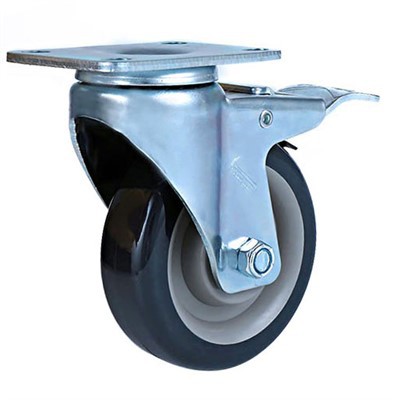
Hey there! As a supplier of Industrial Cast Iron Casters, I often get asked about the chemical stability of these bad boys. So, I thought I'd take a moment to break it down for you.
First off, let's talk about what industrial cast iron casters are. These are heavy - duty casters made from cast iron, which is an alloy mainly composed of iron, carbon, and silicon, along with small amounts of other elements like manganese, sulfur, and phosphorus. They're used in a wide range of industrial applications because they're tough, can handle heavy loads, and are relatively inexpensive compared to some other materials.
Now, onto chemical stability. Chemical stability refers to how well a material resists chemical reactions under different environmental conditions. For industrial cast iron casters, this is super important. After all, they're going to be exposed to all sorts of stuff in industrial settings.
Exposure to Rust - the Achilles' Heel?
One of the biggest threats to the chemical stability of cast iron casters is rust. Rust is essentially the oxidation of iron when it comes into contact with oxygen and water. In industrial environments, where there might be high humidity, spills, or even direct contact with water in some cases, cast iron casters are at risk.
When iron rusts, it forms iron oxide, which is a flaky, brittle substance. Over time, rust can eat away at the surface of the caster, weakening its structure and reducing its load - bearing capacity. This can be a real problem in industries where safety and reliability are crucial, like in heavy - machinery transportation or in warehouses with high - volume traffic.
But don't worry, there are ways to combat this. A common solution is to coat the cast iron casters. There are different types of coatings available, such as paint, powder coating, or galvanizing. Paint acts as a physical barrier between the iron and the environment, preventing oxygen and water from reaching the surface. Powder coating is a more durable option, as it forms a tough, uniform layer on the caster. Galvanizing involves applying a layer of zinc to the cast iron. Zinc is more reactive than iron, so it corrodes first, sacrificing itself to protect the iron underneath.
Resistance to Chemicals
Industrial settings aren't just filled with water and oxygen; they can also have all sorts of chemicals. Acids, alkalis, solvents, and salts are just a few examples. The chemical stability of cast iron casters against these substances depends on the specific chemical and the composition of the cast iron itself.
Acids can be particularly harsh on cast iron. Strong acids like hydrochloric acid or sulfuric acid can react with the iron in the cast iron, dissolving it. This can quickly destroy the caster, leading to failure. Alkalis, on the other hand, are generally less reactive with cast iron, but concentrated alkaline solutions can still cause corrosion over time.


Salts can also accelerate the corrosion process. When salt is present in the environment, it can increase the conductivity of water, making it easier for electrons to flow and speeding up the rusting reaction. For example, in a marine - related industrial environment, where saltwater is present, cast iron casters need to be extra well - protected.
If you're working in a chemical - heavy environment, you might want to consider some of our other products like Heavy Duty PU Iron Core Shelf Casters which offer better chemical resistance due to the polyurethane (PU) component.
High - Temperature Reactions
Another aspect of chemical stability is how cast iron casters react at high temperatures. In some industrial processes, casters may be exposed to heat, either directly as in a foundry or indirectly from nearby heat - generating equipment.
At high temperatures, the carbon in the cast iron can react with oxygen in the air to form carbon dioxide. This process, known as oxidation, can lead to the formation of a scale on the surface of the caster. As the scale grows, it can flake off, leaving the underlying iron exposed to further oxidation.
Moreover, high temperatures can also change the mechanical properties of cast iron. It can become more brittle, reducing its ability to withstand loads. This is especially important in applications where the casters need to be reliable under both heavy loads and high - temperature conditions, like in some metal - processing industries.
How Our Cast Iron Casters Stand Up
At our company, we understand the importance of chemical stability. That's why we take steps to ensure that our industrial cast iron casters can handle different environments.
We start by carefully controlling the composition of the cast iron. By adjusting the amounts of carbon, silicon, and other elements, we can improve the overall performance and chemical resistance of the casters. We also use advanced coating techniques to provide long - lasting protection against rust and other forms of corrosion.
But we also know that sometimes, cast iron might not be the best choice for every situation. That's why we offer a wide range of caster options, including 8 in Caster Wheels, 8 Inch Black Rubber Tyre Casters, Steel Caster Wheels Heavy Duty, and Solid PU Casters. Each of these products has its own unique properties and chemical stability characteristics, allowing you to choose the best option for your specific needs.
Get in Touch for Your Caster Needs
If you're in the market for industrial casters, whether it's for a brand - new project or to replace some old, worn - out casters, we'd love to hear from you. Our team of experts can help you figure out which type of caster is best suited for your environment, taking into account factors like chemical exposure, load capacity, and temperature requirements.
Don't hesitate to reach out to us for a quote or to discuss your specific needs. We're here to make sure you get the best possible casters for your industrial applications.
References
- "Corrosion of Metals" by Uhlig, H. H., and Revie, R. W., Wiley - Interscience, 1985.
- "Materials Science and Engineering: An Introduction" by Callister, W. D., and Rethwisch, D. G., Wiley, 2014.
- "Industrial Caster Handbook" - Industry - specific publication on the properties and applications of casters.